


When the world's leading art fair realized it was not enough
Art Basel is the world's most prestigious art fair. But prestige peaks for a few days a year. The real question was what VIP collectors needed the other 360 days — and whether Art Basel was positioned to answer it. Vendbridge applied its Customer-Focused Innovation methodology to measure what VIP collectors truly want.
The research overturned a core assumption: VIP collectors are not primarily motivated by financial return or social status. Self-realization dominates. Collectors faced real, unsolved problems that Art Basel was uniquely positioned to address. The outcome was a concrete, prioritized roadmap for "Digital Art Basel 365" — a year-round engagement strategy built on what collectors actually struggle with, not on what the organization assumed about them.
The world's best fair and a 360-day blind spot
Art Basel occupies a singular position in the global art market. Run by MCH Group, it is the fair by which all others are measured — a gathering of the world's most important galleries, works, and collectors, staged across Basel, Miami Beach, and Hong Kong. For the galleries that exhibit and the collectors who attend, participation is not a commercial transaction. It is a signal of belonging to the highest tier of the art world.
VIP collectors sit at the center of this ecosystem. They are Art Basel's most valuable audience: high-frequency buyers with global reach, deep relationships with galleries, and the resources to act decisively. Art Basel had cultivated these relationships carefully over decades. It knew who they were. It knew how to attract them to the fair.
What it did not know — with any precision — was what these collectors needed when the fair was not running.
When great relationships stop producing insight
The strategic question Art Basel brought to Vendbridge was specific: how do we build a digital strategy that grows revenue, and how do we know it will work?
The organization had no shortage of ideas. Digital platforms, online viewing rooms, collector services, community tools — the options were plentiful. The problem was that none of them were grounded in evidence. Art Basel had opinions about what VIP collectors wanted. Its gallery partners had opinions. Its leadership team had opinions. But the collectors themselves had not been asked in any systematic way.
Without that evidence, any digital investment was a bet. Some bets would pay off. Many would not. And in a market where VIP collector relationships take years to build, a misaligned product is not just a wasted investment — it is a signal that the organization does not understand its own audience.
Art Basel needed to replace assumption with fact.
Asking collectors what they want is not the same as knowing what they need
The instinctive answer was to ask collectors what they wanted. Run a survey. Hold some focus groups. Map the feedback to features. This is how most organizations approach the problem — and it is why most digital strategies in the cultural sector land short of their ambitions.
The issue is not a lack of research. It is a lack of the right research. When you ask people what they want, you get answers shaped by what they already know, what they are willing to say in a group, and what they assume you are capable of delivering. You get preferences, not pain points. You get wish lists, not strategy.
There was a second, more specific complication. Art Basel carried a powerful internal assumption about its audience: that VIP collectors are motivated by prestige, financial return, and social access. This assumption was reasonable. It matched the public image of the art market. It informed how the fair was positioned, how VIP services were designed, and how digital concepts were being evaluated.
If that assumption was wrong — or even partially wrong — then the entire direction of the digital strategy was at risk of being built on a false foundation.
Vendbridge's role was not to validate the strategy Art Basel already had in mind. It was to find out what was actually true.
One hundred metrics, one overturned assumption, one clear direction
Vendbridge applied its CFI (Customer-Focused Innovation) methodology to map the full value landscape of VIP art collectors. The work ran in two phases.
Phase one: qualitative discovery. Vendbridge conducted 42 in-depth interviews with VIP collectors across four markets: London, New York, Switzerland, and Hong Kong. The interviews were structured around the collectors' full annual journey — not just their behavior at art fairs, but every dimension of how they find, evaluate, acquire, and manage art across the year. The output was a set of 100 value metrics: precise, solution-agnostic statements describing how collectors assess whether their needs are being met at each step.
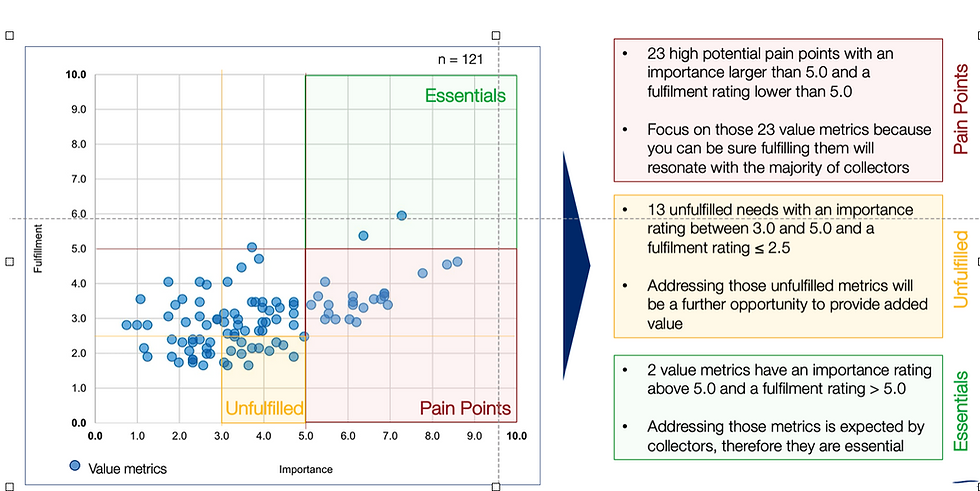
Phase two: quantitative validation. The 100 metrics were validated with a broader sample of 121 VIP collectors globally. For each metric, collectors rated both importance and current fulfillment. This produced a clear, ranked map of where the gap between what collectors need and what the market currently delivers is largest — the unmet needs that represent the highest-value opportunity for Art Basel to address.
What the data showed. The findings overturned the central assumption. VIP collectors are not primarily motivated by prestige or financial return. Self-realization dominates — the drive to develop taste, deepen knowledge, build a coherent collection that reflects a genuine point of view. This is not a marginal finding. It is a structural reframe of what "value" means to Art Basel's most important audience, and it has direct consequences for what a digital strategy should be built around.
The research identified 8 universal pain areas affecting all VIP collectors globally, plus 4 additional pain areas tied to specific collector profiles. The most acute pain concentrates in two phases of the collector journey: the purchase process and ongoing collection management — each carrying 7 high-priority pain points.
The strategic output. Vendbridge translated the evidence into a concrete strategic direction: "Digital Art Basel 365." Rather than optimizing the fair experience, Art Basel's digital growth opportunity lies in building year-round engagement with collectors — addressing the practical frictions and knowledge gaps that currently go unsolved across the 360 days between events. The roadmap included prioritized innovation concepts, each mapped to specific unmet needs and assigned to relevant parts of the MCH Group structure.
What Art Basel gained. The project delivered three things that internal opinion could never produce: a factual picture of collector motivation that replaced a decade-old assumption; a prioritized map of where the largest unmet needs sit across the collector journey; and a digital strategy with a clear evidence base — one that could be defended to leadership, tested against reality, and refined over time.
The shift from opinion to evidence is not a methodological nicety. It is the difference between a digital strategy that serves collectors and one that serves the organization's self-image. Art Basel chose the former.
What this means beyond Art Basel
The art market is not unique in this dynamic. Every premium business faces the same temptation: to assume it knows its best customers because it has served them for a long time. Long relationships produce familiarity. They do not automatically produce insight.
The collectors Art Basel had cultivated for years were underserved in ways the organization could not see — because it had never systematically measured the gap between what collectors needed and what the market delivered. That gap is where growth lives.
This is the work Vendbridge does. Not research for its own sake. Evidence that makes strategy defensible, investment decisions sharper, and the distance between a good idea and a winning product significantly shorter.
Don't fund opinions. Fund problems worth solving.


Comments